The Star Ratings Ruling Removed Less Than the Commentary Suggests
Since late May, much of the Medicare Advantage quality community has treated a federal court ruling as though it retired twenty Star measures. Traced through the ruling, the CMS memo, and the published 2027 measure set, that reading is wrong in the direction that costs a plan money: nineteen of the twenty are back for 2027, several heavier, and work underway now lands in the 2028 ratings. A read on what actually changed and where the risk really sits.
- ▸A May 2026 federal ruling struck 20 measures from one plan's 2026 Star Rating on two grounds; CMS then voluntarily recalculated every plan's 2027 bonus ratings using only one of them.
- ▸Ten struck measures survived the recalculation and eight never-challenged measures were dropped, including Drug Plan Quality Improvement, the heaviest-weighted measure CMS assigns.
- ▸CMS's published 2027 measure set already contains 19 of the 20 struck measures, several at higher weight; the physical- and mental-health outcome measures move from weight 1 to weight 3.
- ▸The recalculation applies to the 2027 bonus year only. Work a plan begins now lands in the 2028 Star Ratings, so a plan that defunded a struck measure defunded something it will still be scored on.
- ▸Measures struck for missing rulemaking (member experience, care coordination, surveys) are the safer investment; those struck on statutory grounds (adherence, call center) carry the real uncertainty.
Since late May, the Medicare Advantage quality community has been working through a federal court decision that, on first reading, appears to have removed twenty measures from the Star Ratings. A good deal of the commentary since has treated those measures as retired, and some plans may be moving budget on that basis. Having worked through the ruling, the CMS memo that followed, and the measure files published since, we would suggest that reading is mistaken, and mistaken in the direction that costs a plan money.
What actually happened
In May, a federal judge in the Southern District of Georgia ruled that CMS had built Clover Health's 2026 Star Rating on twenty measures it was not entitled to use. The court gave two independent reasons.
Ten measures relied on data the governing statute does not authorize. That is, CMS may build ratings on the kinds of data it was already collecting in 2003, which in practice means the HEDIS clinical measures and the two member surveys, and these ten drew on something else: pharmacy claims, secret-shopper call center tests, appeals records. The other ten were adopted without notice-and-comment rulemaking. Since a Star Rating determines what a plan is paid, adding a measure is effectively a payment rule, and payment rules require a public comment period.
The order applied to Clover's rating and to nothing else. CMS then chose, voluntarily, to redo every plan's 2027 bonus ratings, and when it did so it applied only the first of the court's two reasons.
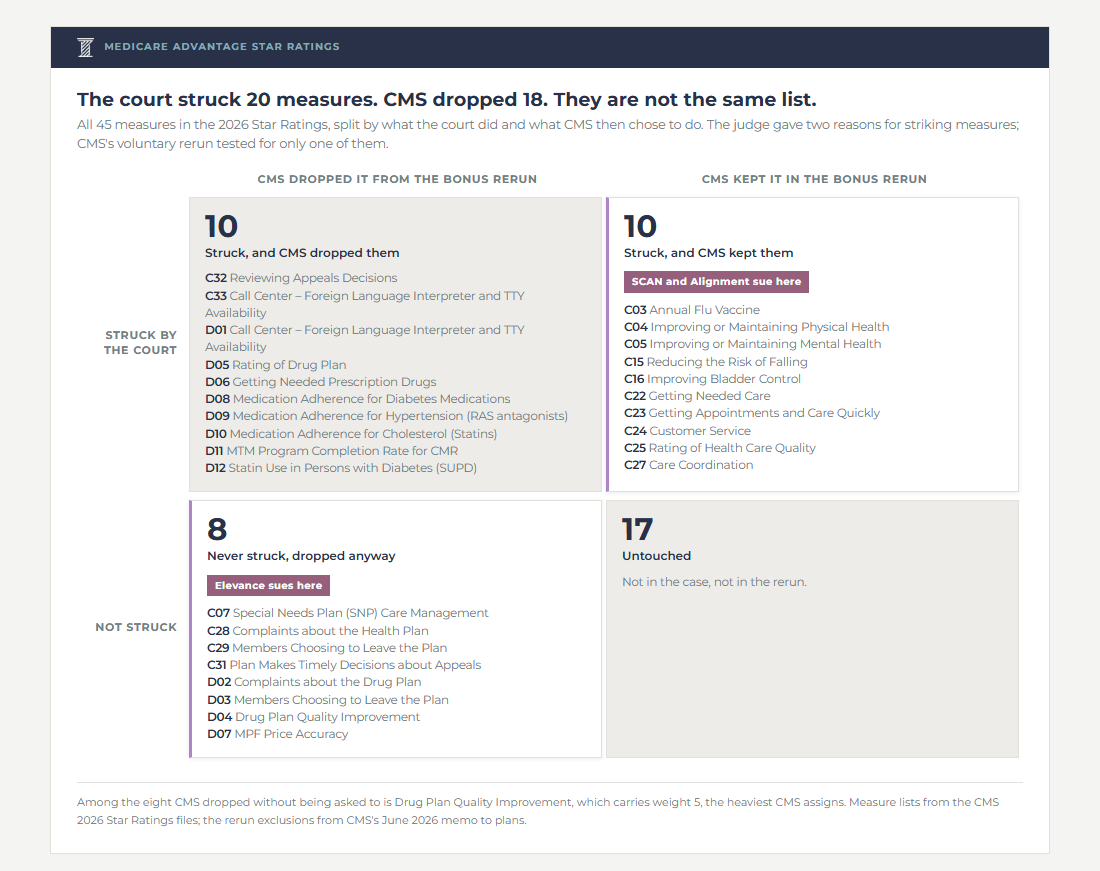
Because CMS filtered on data source alone, ten measures the court struck survived the recalculation; all ten are survey measures, and survey data passes a data-source test comfortably. At the same time, eight measures nobody had challenged were dropped, because CMS's filter is broader than the court's finding. Among them is Drug Plan Quality Improvement, which carries the heaviest weight CMS assigns.
Where things stand
Predictably, plans have now sued from both directions. Elevance argues CMS cut the wrong things, pointing at the eight measures that were never at issue. SCAN Health Plan and Alignment Healthcare argue CMS did not cut enough, and that the ten survey measures should have gone as well. CMS, for its part, has appealed the original ruling, which means its official position is that all twenty measures were lawful all along. A separate Humana challenge to the 2025 ratings, resting on the same theories, is pending at the Fifth Circuit.
The recalculation was structured so no plan could be harmed, since each contract received the better of its original rating and its recalculated one. Forty-seven contracts moved up without changing anything they do. For most plans nothing moved, and their published ratings still reflect all forty-five measures.
What CMS has published for next year
CMS has already published the 2027 measure set, so this part does not depend on how the litigation resolves. Nineteen of the twenty struck measures are in it.
Several are not merely present but heavier than they were. Improving or Maintaining Physical Health and Improving or Maintaining Mental Health, both struck by the court, move from a weight of one to a weight of three. The three medication adherence measures, also struck, remain at three. Only one struck measure leaves the set, and even that one returns as a new measure in 2029 after two years on the display page.
Three measures do depart: Care for Older Adults Pain Assessment, Medication Reconciliation Post-Discharge, and the medication therapy management completion rate. Three others arrive, each at a weight of one: a functional status assessment for older adults, concurrent use of opioids and benzodiazepines, and a polypharmacy measure for anticholinergic medications. Colorectal cancer screening has been respecified and is treated as new, which means historical performance does not carry forward.

What this means for planning
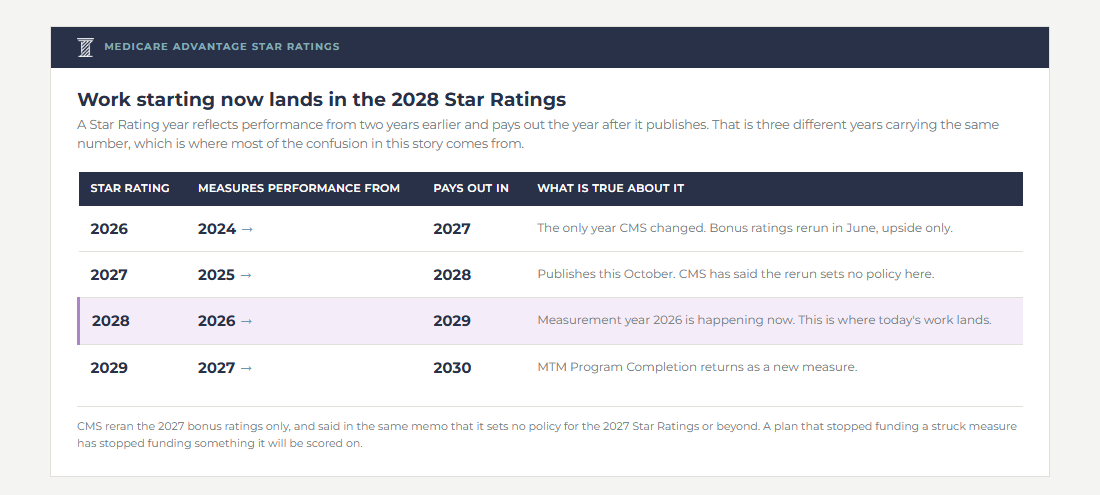
Work a plan begins today lands in the 2028 Star Ratings, two full cycles beyond the only year CMS has changed anything about. CMS said explicitly that the recalculation applies to the 2027 bonus year alone and sets no policy beyond it. A plan that has stopped funding a struck measure has therefore stopped funding something it will be scored on.
How we would think about capability investment
While the litigation remains unresolved, the two groups of measures do not carry equal risk.
The ten struck for want of rulemaking have a procedural defect, and CMS can cure that by itself, simply by running the measures through a comment period. Most observers expect exactly that in the next Part C and D rule. Consequently, member experience, care coordination, and the survey-driven outcome measures are, in our view, the safest place a plan can put money right now, and we would not slow that work at all.
The ten struck on statutory grounds carry the uncertainty, since CMS cannot cure a statutory defect with paperwork; it would need either a favorable appellate ruling or new authority from Congress. This group contains medication adherence and the call center measures, two of the most crowded vendor categories in the market. We are not suggesting a plan abandon them, since CMS is presently defending and scoring them. We would suggest that any multi-year commitment there be structured so it can be unwound, and that a plan ask a vendor selling into it how its contract accounts for the measure disappearing.
The position we would encourage plans to adopt is therefore a narrow one. Very little has actually been removed. What has changed is how risk is distributed across the measure set, which makes this a planning question before it is a legal one.
A 3Pillars Solutions perspective. Sources: the Clover Health ruling (S.D. Ga., May 2026), the CMS recalculation memo, and the published 2027 Star Ratings measure set.