Elevance Named Its Own Medicaid Exit Test. Four States Fail It.
Elevance told investors it will exit more Medicaid markets but named none. On the same call it named its own test: alignment with duals, the one leg outsiders can score on public data. Measured that way, four active states fail outright, the same zero DC and Nebraska carried out of the market. A watchlist built from what the company said, not what it left unsaid.
- ▸On its July 2026 earnings call Elevance said it will exit more Medicaid markets over 12 to 18 months but named no states; on the same call it named its own criterion: alignment with duals.
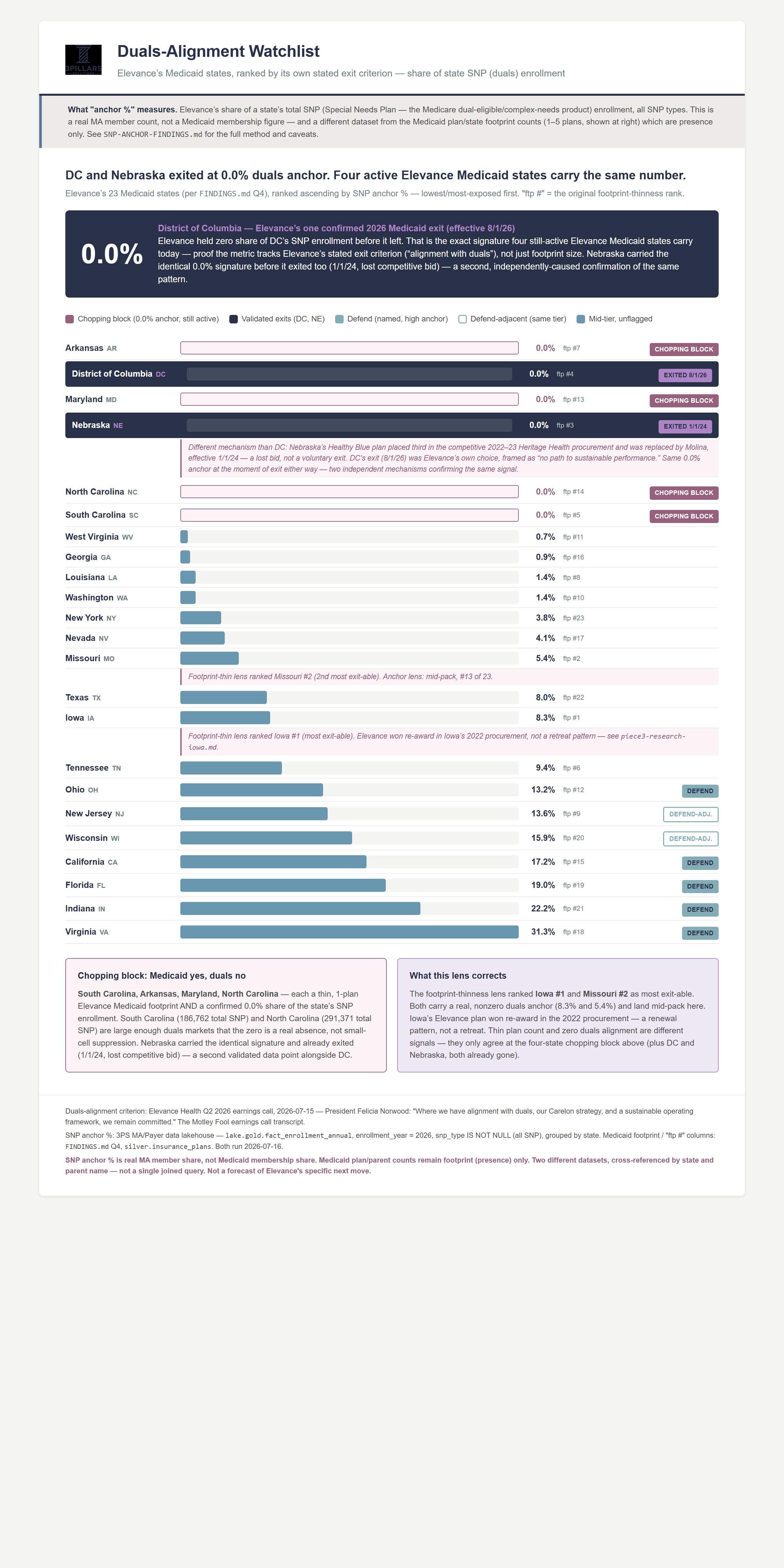
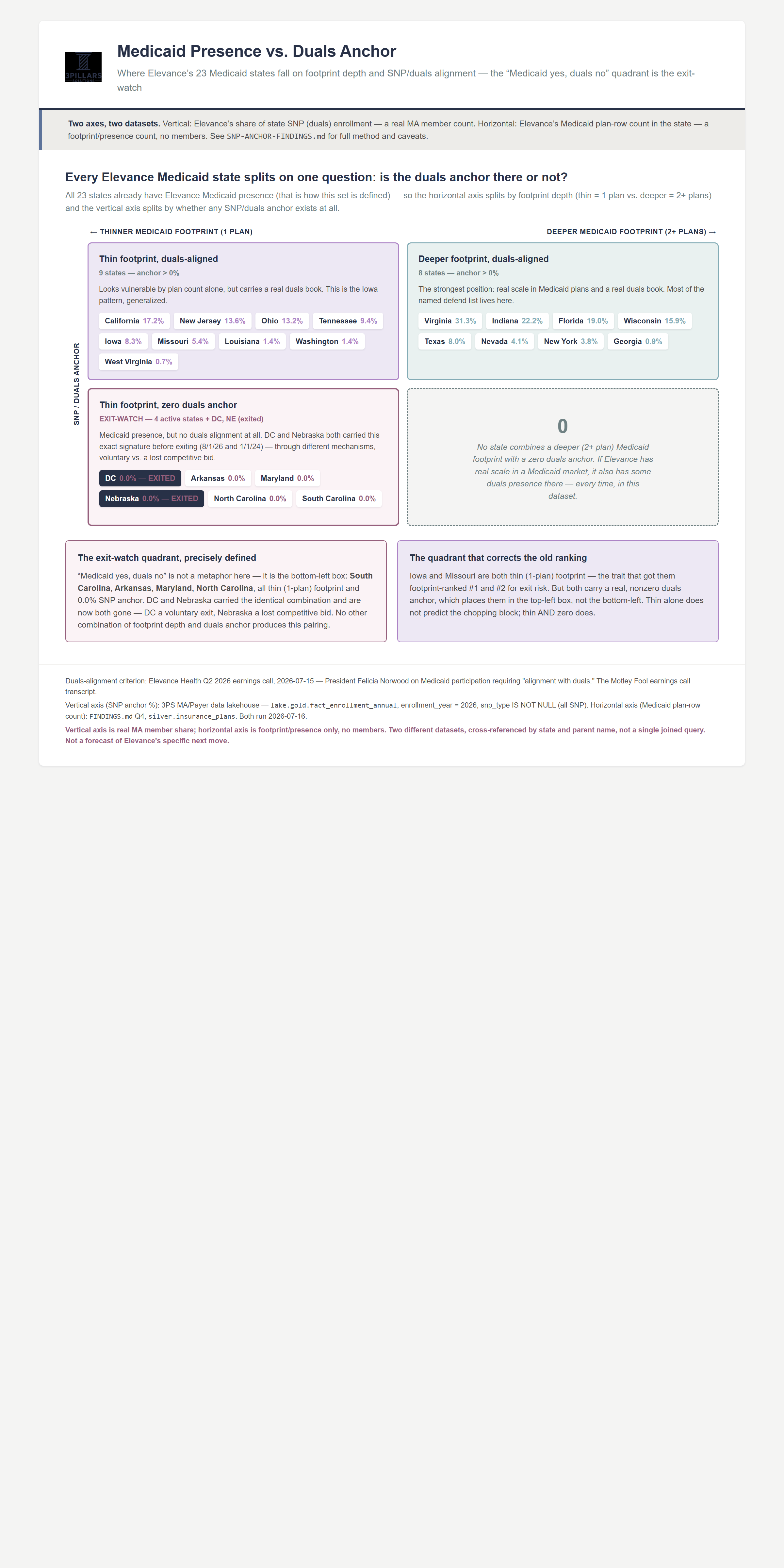
- ▸Scored as each state's share of SNP (duals) enrollment, four active Elevance Medicaid states sit at a 0.0% anchor: Maryland, North Carolina, South Carolina, and Arkansas.
- ▸Both Elevance departures on record, DC (2026) and Nebraska (2024), carried the same zero, so the metric tracks the company's stated exit criterion rather than footprint size.
- ▸Footprint-thinness and rate screens both mislead: they rank Iowa (a renewal, not a retreat) most exit-able and miss DC entirely.
- ▸Owner-normalized, contract-level SNP shares from public CMS data; the Medicaid side is presence only, so the anchor is a proxy for Elevance's criterion, not a Medicaid market-share figure.
Elevance is leaving DC Medicaid on August 1, and on its July 15 earnings call it told investors DC will not be the last. CEO Gail Boudreaux: "we expect to exit additional Medicaid markets over the next 12 to 18 months where we do not see a path to sustainable performance." She named no states. So if your work touches Medicaid managed care - you compete with Elevance, you regulate it, you sell to it, or your state writes checks to it - you have spent the past two days doing what everyone else has: guessing.
The guessing is more solvable than it looks, because on the same call the company explained its own test. President Felicia Norwood: "Medicaid participation has to make strategic and financial sense for us within our diversified portfolio. Where we have alignment with duals, our Carelon strategy, and a sustainable operating framework, we remain committed." Two of those three legs are internal; nobody outside the building can score Carelon strategy or "sustainable operating framework." But alignment with duals shows up in public enrollment data, state by state, today.
So we measured it. That's what we'll get into: what the measurement is, why the one exit already on the books validates it, the four active states that fail it outright, the fifth state that already fell, and - since a watchlist that oversells itself is worse than no watchlist - what this metric can't tell you.
Why the obvious screens fail
Start with the screens people reach for first, because both of them break.
Screen one is footprint: find the states where Elevance's Medicaid presence is thinnest and assume those go first. The problem is that thin is the norm. Somewhere between 85 and 96 percent of each national carrier's Medicaid states run on one or two plans, Elevance included, and a screen that flags nearly the whole map isn't a screen. Worse, when we ranked Elevance's Medicaid states by footprint thinness, the results actively misled. The state that ranked most exit-able, Iowa, turns out to be one where Elevance has operated continuously since 2016, survived two competitors' exits, and won re-award in the last competitive procurement - a renewal pattern, not a retreat pattern. Meanwhile DC, where the exit is actually happening, ranked a middling fourth.
Screen two is rates: find the states squeezing hardest and assume the carrier flees the squeeze. Rates matter enormously - Maryland is about to show how much - but as a national exit predictor they fail on the company's own testimony. CFO Mark Kaye told the same call that Medicaid rate trend is running "modestly favorable to our expectations." A company does not exit markets over rates while telling investors rates are beating its expectations. Whatever drives the exits, it is not a blanket rate story.
How do you measure "alignment with duals"?
Here it's worth slowing down for the mechanics, because the metric only means something if you know what it counts.
Dual-eligibles - "duals" - are people enrolled in Medicare and Medicaid at the same time. Mostly low-income seniors and younger people with significant disabilities, they are the most medically and financially complex members either program serves, and they sit exactly at the seam between a carrier's Medicare business and its Medicaid business. When a carrier has a duals strategy in a state, it almost always shows up as a Special Needs Plan: a Medicare Advantage product built for complex-needs members, with a variant (the D-SNP) built for duals specifically. SNP enrollment is public, member-level CMS data.
So the measurement is Elevance's share of each state's total SNP enrollment. Two honesty notes before the numbers. First, we counted all SNP types combined - dual-eligible, chronic-condition, and institutional - rather than D-SNPs alone. That's a generous net: it can only add Elevance members, so any state reading zero on the broad measure would read zero on the narrower duals-only cut too. Second, and this one matters: the SNP shares are real Medicare Advantage member counts, but the Medicaid side of this analysis is presence only - which states, which plans, no membership. Nothing in this piece is a claim about Elevance's share of any state's Medicaid members. The anchor share is a proxy for the criterion Elevance itself named, not a Medicaid market-share statistic.
Does the proxy track the actual decision? The one exit on the books says yes. Elevance holds 0.0 percent of DC's SNP enrollment - zero of the District's 16,776 SNP members. In the one market where the company has already decided, it had no duals anchor at all. (The footprint screen, remember, had DC fourth.)
Run the same measurement across the full map and four more active Elevance Medicaid states carry the identical signature: Maryland, zero of 44,693; North Carolina, zero of 291,371; South Carolina, zero of 186,762; Arkansas, zero of 125,624. Not thin. Zero.
Nebraska already showed us the ending
I said four active states, and "active" is carrying some weight in that sentence, because the list used to have a fifth - and what happened to it is the best reason to take the other four seriously.
Nebraska carried the same zero: no Elevance share of the state's 22,682 SNP members. Our footprint dataset still listed Nebraska as an active Elevance Medicaid state, which turned out to be stale. The state's December 2025 Medicaid annual report names its three MCOs - Nebraska Total Care, UnitedHealthcare, Molina - and no Elevance entity appears anywhere in the document. Elevance's Healthy Blue lost Nebraska's Heritage Health procurement in 2022: third place in the written scoring, narrowly ahead of Molina, until the state added oral interviews and Molina moved past it. A bid protest didn't change the outcome. Healthy Blue was out of Nebraska Medicaid on January 1, 2024.
Be clear about what that is and isn't. Nebraska is not part of the announced exit wave - it predates the 12-to-18-month window by two and a half years, and the mechanism was different: a state showed the carrier the door; the carrier didn't choose to leave. That is a materially different failure mode from DC's voluntary negotiated exit. But the signature matches. The two departures on Elevance's recent Medicaid record - Nebraska in 2024, DC now - both sat at zero. It's an open question in my mind whether a missing anchor helps cause these outcomes or just travels with them. You can tell either story (a carrier with no duals book has less strategic reason to sharpen its pencil to keep a state; a carrier that never built the duals product was never that committed to begin with), but both stories point the same direction, and two for two is not a record I'd bet against.
Maryland is the sharpest live case
Maryland pairs the zero anchor with a rate squeeze the state documents itself, in its own reports, in plain numbers.
The mechanism first. Maryland's HealthChoice program pays nine MCOs, and the health department presents actuarially sound rate ranges to the state budget office each year. Per the department's September 2025 report to the legislature, the budget office "typically only approves rates at the bottom of" that range. That is standing practice, stated in the department's own report, and in 2025 the bottom-of-range choice saved the program $67 million. The same document describes a 1.3 percent program-wide profit target the department itself calls "lower than many other states," and an 85 percent loss-ratio floor: spend at least 85 cents of every premium dollar on care, or remit the difference back to the state.
Against that background, here is Elevance's Wellpoint Maryland in CY2023, the most recent audited year, all from the state's own report:
Paid the least per member, made the most dollars, owed a penalty for it. If you're thinking a step ahead, you've probably already built the objection: why would a carrier walk away from the most profitable book in the program? Fair question - and the next year answers it. In preliminary, unaudited CY2024 data, Wellpoint's loss ratio came in at 85.2 percent, just clearing the floor; its remittance dropped to zero; and its profit fell by about 40 percent. I want to disclose that improvement plainly, because it would be convenient to quote only the ugly year: on the compliance measure, CY2024 Wellpoint looks fine. But notice what the two years say together. The CY2023 shape drew a $35.8 million penalty; the CY2024 shape cost 40 percent of the profit. Those are two frames of the same squeeze, and the squeeze is state policy.
One more read, and I'll flag it as mine: a bottom-of-the-program capitation combined with a below-floor loss ratio and the program's highest profit is the shape you'd expect from a comparatively low-acuity book - a plan that isn't carrying the sickest, costliest members. The state's report never discusses acuity or duals mix by MCO; that inference is my read of the financial shape, not the state's conclusion. But it is consistent with what the enrollment data says independently: Wellpoint has no duals product in Maryland to carry them. Zero of 44,693, before the CY2024 improvement and after it. The loss ratio moved; the anchor didn't.
Now add the budget picture. Maryland faces an FY2027 budget gap reported at $1.5 to 1.6 billion, with Medicaid behavioral health spending named by the legislature's own analysts as a driver - $217 million of a $778 million overspend against forecast. The health department's report says MCO quality payments are already "part of the discussion" for building the 2027 budget. And a state health official has warned that pending federal Medicaid changes could cost Maryland up to $2.7 billion a year in federal funding once fully implemented. You can argue about how much of that materializes and when. You cannot find anything in that stack pointing toward looser rates.
One last structural fact. Maryland credentials any qualified MCO on annual agreements; there is no Nebraska-style procurement to lose. If Elevance leaves Maryland, it will look like DC: a voluntary walk, which is exactly the mechanism Boudreaux described to investors.
North Carolina is the big one
If Maryland is the sharpest case, North Carolina is the largest. Healthy Blue Care Together is a statewide Standard Plan across all 100 counties, in the market since North Carolina launched Medicaid managed care in 2021, run jointly with Blue Cross NC. The DC book Elevance is exiting was a shared contract serving roughly 250,000 people; North Carolina is a statewide book that dwarfs it.
The zero needs one technical defense here, so let me give it. CMS suppresses small enrollment cells in public MA data to protect member privacy, which means that in a small market, a tiny real presence could in theory read as zero. North Carolina's SNP market is 291,371 members - far too large for suppression to hide any Elevance presence of consequence. This zero is genuine absence.
And North Carolina is the one state where the anchor is doing something worse than not existing: it is receding, on the record, in real time. Unlike South Carolina, Elevance did have a duals-adjacent role here: a joint "Healthy Blue + Medicare" D-SNP operated with Blue Cross NC. On January 1, 2026, Blue Cross NC took over full administration of that product, ending the arrangement it had described as run "in partnership with Elevance." Whatever claim Elevance had on a North Carolina duals strategy transferred to its partner in January. By the company's own criterion, the largest state on the zero list has now lost the last of its anchor.
The other two zeros, and the states the same test protects
South Carolina's zero comes with independent confirmation, which in this kind of work is rare enough to pause on. At the end of 2025 the state wound down Healthy Connections Prime, its Medicare-Medicaid integration demonstration (a federally driven sunset of the whole national demonstration, not a South Carolina quirk), and moved those members to standalone D-SNPs. The wind-down record names the three legacy integrated plans; Elevance isn't among them. The successor D-SNP carriers are named too; no Elevance there either. Two separate state document trails and the enrollment data all return the same answer: Elevance has never held a duals product in South Carolina.
Arkansas barely belongs on the list, and its most quotable number is a good test of whether you want the truth or just a scary chart. Elevance's only Arkansas Medicaid presence is Summit Community Care, a PASSE - a carve-out serving people with complex behavioral health needs and intellectual and developmental disabilities. Not general Medicaid, not duals; a structurally different book. Arkansas DHS's own Medicaid Sustainability Review reports average PASSE capitation down 23 percent from SFY2019 to SFY2023, the most dramatic rate number in this entire research run. There's the scary chart. But the same review shows total PASSE expenditures rose 15 percent over roughly the same window, and both numbers can only coexist if enrollment grew enormously - run the arithmetic and member-months have to grow by something like 45 to 50 percent or more for a 23 percent per-member decline to sit alongside 15 percent total growth. Which means much of that decline is very likely a mix effect: a fast-growing membership pulling the average down, plausibly by adding lower-acuity members faster than higher-acuity ones, not a clean rate cut to a fixed population. I did not find a document that separates the rate change from the mix change, so I can't tell you how much of the 23 percent is real rate pressure. Neither can anyone else quoting it. "Arkansas cut rates 23 percent" flattens the confound out of existence. Don't repeat it.
The same test runs the other direction, and it's worth two sentences. Virginia (31.3 percent of state SNP enrollment), Indiana (22.2), Florida (19.0), California (17.2), and Ohio (13.2) are Elevance's deepest duals anchors among its Medicaid states, with New Jersey (13.6) and Wisconsin (15.9) in the same tier. By the company's own criterion these are the books it defends - sticky for exactly the reason the zeros aren't.
What this metric can't tell you
Four limits, stated plainly.
It locates where to watch, not who leaves. Exit decisions turn on cost trend, rate adequacy, and contract economics, and none of those lives in enrollment data. Elevance said 12 to 18 months and named no states. Nothing here changes either fact.
The anchor share is a proxy, not the criterion itself. The SNP counts are real member-level MA enrollment; the Medicaid side of the cross-reference is presence only. And "alignment with duals" as Norwood used it presumably includes things no enrollment file can see - Carelon overlap, state relationships, the internal economics of those members.
Small markets can hide small numbers. The suppression caveat from the North Carolina section cuts the other way in Maryland: a 44,693-member SNP market is modest enough that a true but tiny Elevance presence could hide inside the zero, and I can't fully rule that out. North Carolina and South Carolina are too big for that doubt, and DC's zero was validated the hard way: whatever the true number was, it was low enough to sit under an actual exit.
And Nebraska is the reminder that carriers don't always choose. A zero anchor didn't make Elevance walk out of Nebraska; Molina outbid it. The metric flags where the strategic case for staying is thinnest. It does not tell you which door the carrier leaves through, or who opens it.
The Bottom Line
Elevance wrote its own test, and alignment with duals is the one leg of it outsiders can score. Scored on public enrollment data, four of its active Medicaid states fail outright today - the same zero DC carries into its August 1 exit, the same zero Nebraska carried off the map in 2024. The metric won't give you a date, a mechanism, or the press-release language, and I have tried to be honest about everything else it can't do. What it gives you is the shortlist the company's own words imply.
So: watch Maryland first - zero anchor, a state that approves rates at the bottom of the range on purpose, a budget gap with Medicaid's name on it, and no bid to lose, just a walk to take. Watch North Carolina hardest - the biggest book on the list, a zero too large to be a data artifact, and an anchor that finished receding on January 1. Elevance handed everyone its scorecard on July 15. Don't guess. Fill it in.
Enrollment analysis from public CMS SNP enrollment (2026, all SNP types), owner-normalized and traced at the contract level on the 3Pillars MA/Payer data lakehouse; Medicaid presence is footprint only. Sources include the Elevance Q2 2026 earnings call (2026-07-15), Maryland Department of Health MCO loss-ratio reporting (September 2025), Nebraska DHHS and SCDHHS program records, and Arkansas DHS's Medicaid Sustainability Review.